his wall in our family room has been blank since we moved in over five years ago. My husband and I could not agree on what art should go there - which seems to be a theme in our house after counting how many pieces of art I've DIYed as "just for now" placeholders. So in true Samantha form, I decided to make something to go here. After another two years of contemplating what to make went by, I was on a call with a brand I've been working with for quite a while who suggested they'd love to see DIYs completed with their products. Quickly noting what was on my DIY list this year *ahem, art,* I knew I could make something fun work by taking a stunner of a rug and transforming it into a framed piece of art.
Reasons to DIY A Rug Into Framed Art
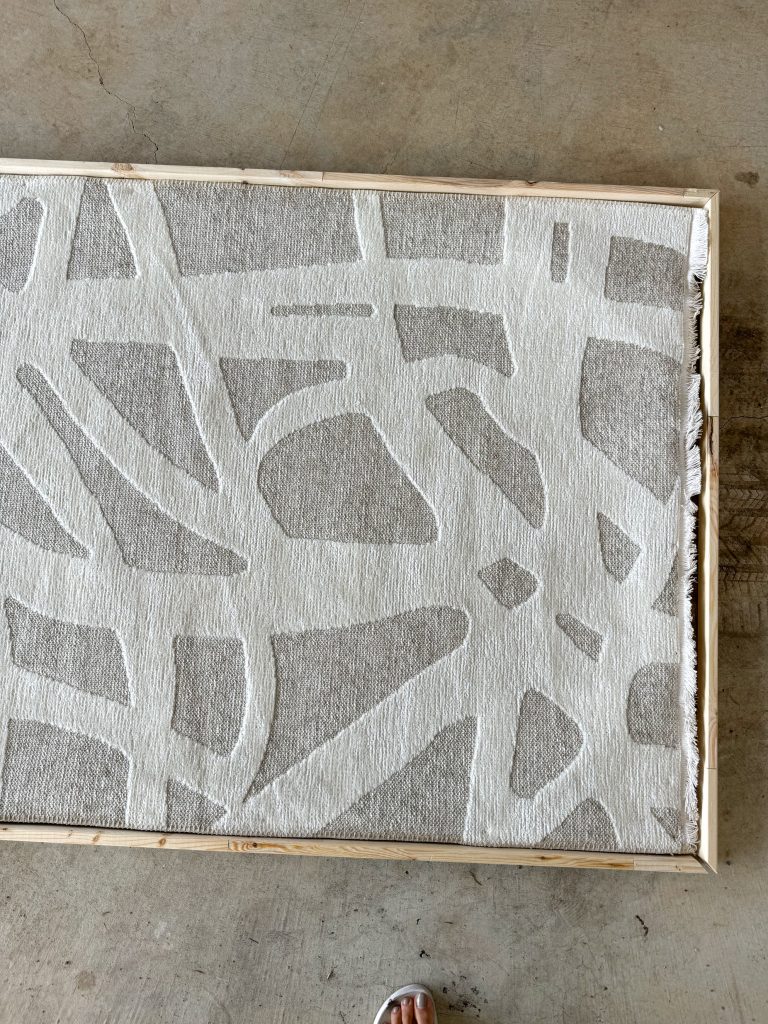
First of all, it’s no surprise that the company I was chatting with was RugsUSA. I love their products so much that I have two separate reviews (one and two) on the various RugsUSA rugs I have or have had throughout my home. Now, I have this one hanging prominently on my family room wall. What I might love about this Cream Claude Abstract Fringe Reversible Area Rug the most is how it seamlessly ties together warm and cool tones in this room. I moved my Melrose Rug from my bedroom to here, and once I did, I immediately “needed” a new sofa. Now I have found the rug turned art has softened the distinct difference between the rug and sofa and saved us a lot of money!
What You Need to DIY a Floating Frame For Your Rug
- 8 x 1x2x8 furring strip board – this would leave you with extra, but I like a buffer and these were inexpensive
- 24 ft of ornamental mouldings (I’m pretty sure these are the ones I used, but make sure the width isn’t too much more than the 1″ (i.e. 3/4″) portion of the furring strip so it can sit flush
- Wood glue
- Clamps
- Nail Gun (optional)
- Kreg Jig (optional)
- Drill (optional)
- Chop saw (or mitre box, or mitre shears)
- Paint, paintbrush, sanding block
How to DIY a Floating Frame For Your Rug
Determine how you want your rug to sit – I wanted my rug to be fully on display so I made my rug support frame the same size as the rug. If you want the rug to wrap around the support frame, you’ll want it to be small enough that the rug can wrap to the back of the frame.
1. Measure your rug width-wise with a furring strip board – mark off how long you need it with a pencil. Using your tool of choice (chop saw, mitre box, etc.), cut a 90-degree angle at your pencil mark. Repeat for a second piece of wood (hint: use the piece you’ve already cut as your guide). Lay your two-width pieces on the rug. Take another furring strip and measure how tall the strip needs to be with a pencil. Cut a 90-degree angle at your pencil mark. Repeat for the second piece of wood (hint: use the piece you’ve already cut as your guide)
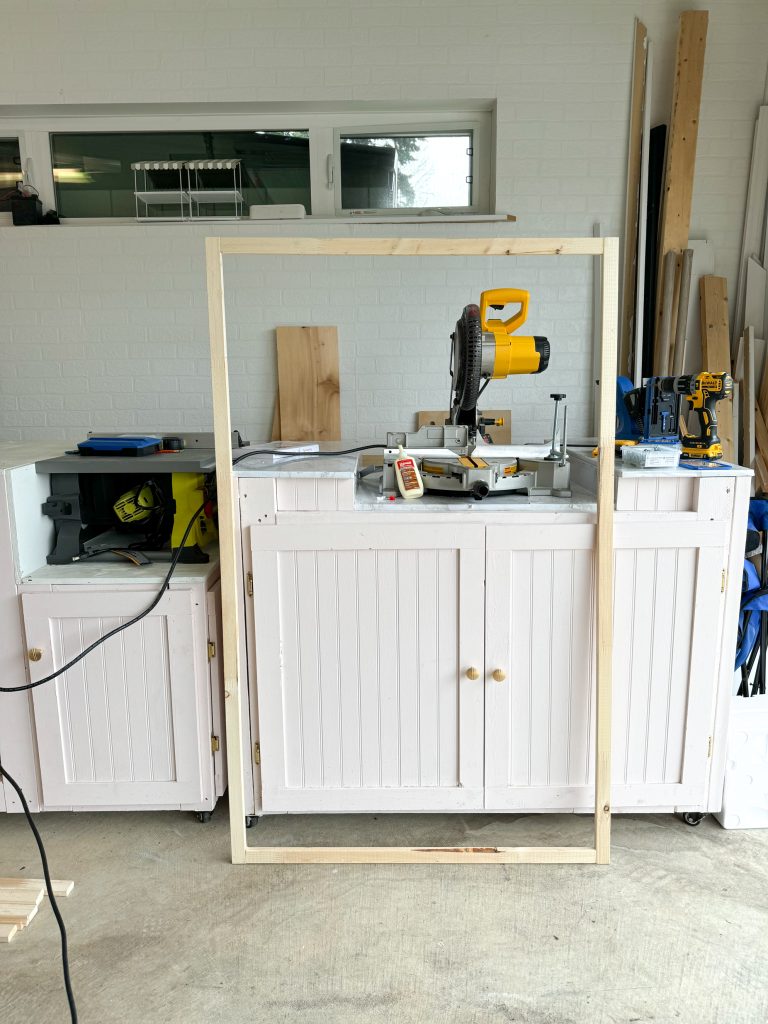
2. Assemble this box frame using your Kreg jig, wood glue, and drill. If you don’t have a Kreg jig, you can always wood glue your frame into place, clamp it, and wait until it dries to move on to the next step. You want this portion of the frame to be made the thin way (3/4″ thick and the 1 3/4″ portion facing towards the sky/ground), as pictured above. It needs to fit inside the real floating frame.
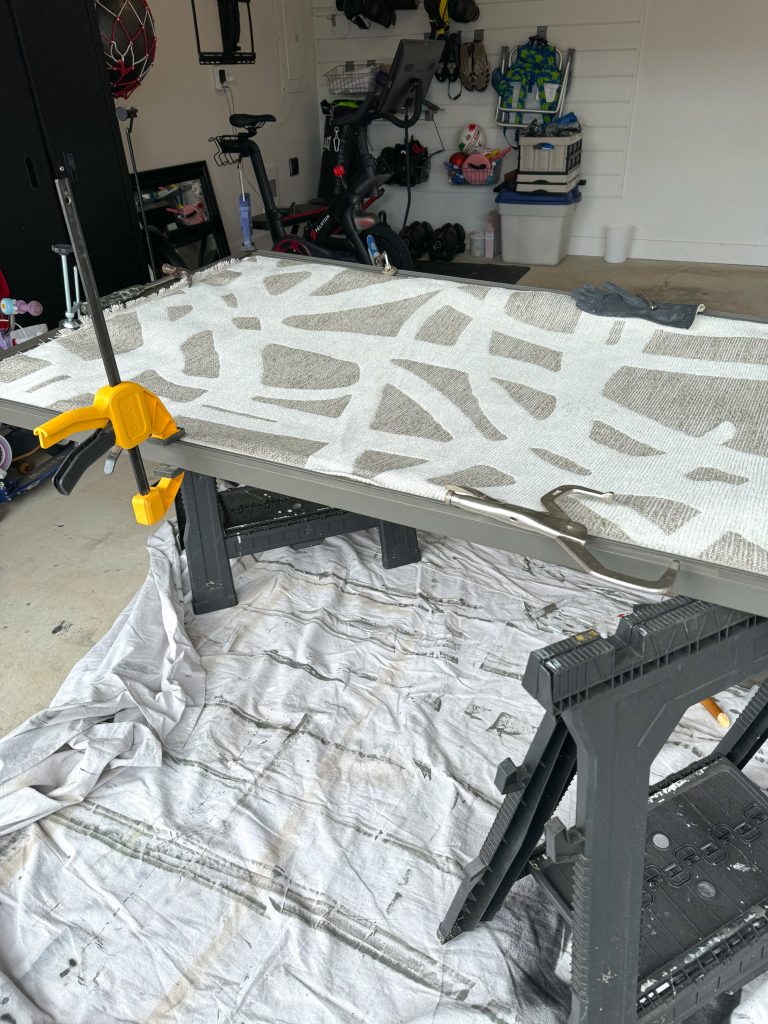
3.Once your wood glue is dried, you can take your nail gun and nail your rug into place.
4. Take another furring strip and chop the smallest amount you can off making a 45-degree angle. Then measure around your frame. This time I like to leave somewhere between 1/4″ and 1/2″ of space between the mounted rug and the new furring strip. You’re doing a mitred corner this go-around and it’s being made the thick way (1 3/4″ thick and the 3/4″ portion facing towards the sky/ground), as pictured above.
5. Mark off how long you need the not-yet-mitred end with a pencil. Then, cut a 45-degree angle with the shorter end of your angle at your pencil mark. Your wood should be a trapezoid shape. Repeat for a second piece of wood (hint: use the piece you’ve already cut as your guide). Lay your two-width pieces on the rug.
6. Take another furring strip and chop the smallest amount you can off making a 45-degree angle. Then measure how tall the strip needs to be with a pencil. Cut a 45-degree angle with the shorter end of your angle at your pencil mark and make sure it’s a trapezoid again. Repeat for the second piece of wood (hint: use the piece you’ve already cut as your guide).
7. Line up your pieces of wood, glue them together using some wood glue and nail the pieces together. Or, clamp and wait it out.
8. Cut four smaller pieces at 45-degree angles into trapezoids to stabilize the frame. Glue and nail the pieces into place. The exact location of these pieces doesn’t matter – but a little on the bigger size will provide more stability.
9. Next, you’re going to take your decorative moulding. Measure and make mitred cuts so the pieces fit perfectly along your furring strip floating frame. Paint the frames in the colour of your choice.
10.Place the DIY framed rug into the DIY floating frame. Nail/glue these two frames together.
11. Finally, glue the decorative moulding pieces on, clamp them down and wait for them to dry.
12. Then hang up your work of art and admire it.
We are nearing a (pretty much) fully decorated house for this year. I have decided only to tackle th
The office also presented an extra challenge because my shelves are two different depths. One is 12
I 'll start by saying I am fully aware we are blessed with a beautiful home, especially in Vanc


Leave a Reply